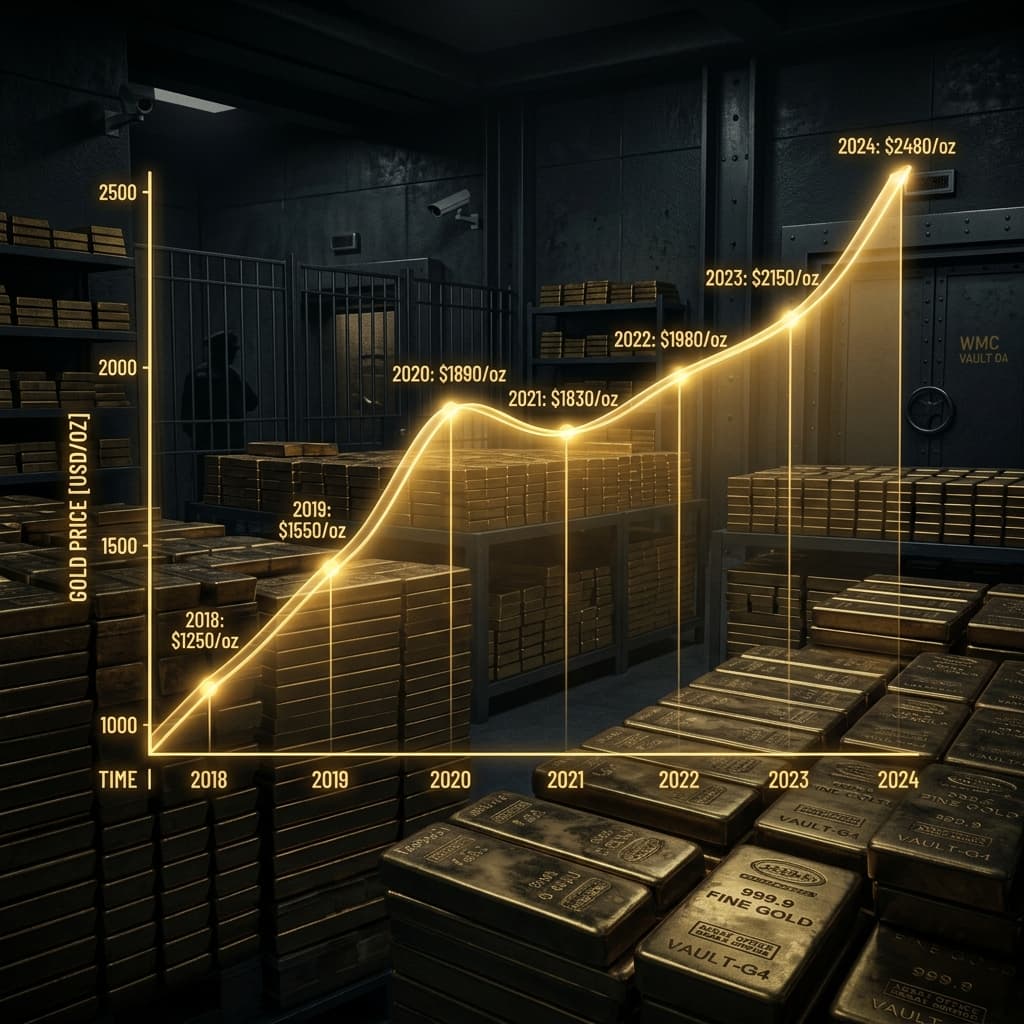
Gold Price Forecast 2026-2030: Institutional Market Outlook
Our research team analyzes supply-demand dynamics, central bank buying, geopolitical factors, and monetary trends to project gold prices through 2030. Base case: $3,500-4,000/oz.
## Executive Summary
Gold stands at a critical inflection point in 2026. Our research team projects $3,500-4,000/oz by 2030 in our base case, with bull case scenarios reaching $5,000-6,000/oz. This outlook is driven by structural supply deficits, record central bank buying, and monetary debasement trends.
Key Projections: - 2026 Year-End: $2,600/oz (+9% from current $2,380) - 2027 Year-End: $2,900/oz (+22%) - 2030 Base Case: $3,500-4,000/oz (+47-68%) - 2030 Bull Case: $5,000-6,000/oz (+110-152%)
Current Market Dynamics (Q1 2026)
Price Context
Gold reached $2,380/oz in March 2026, up 18% year-over-year. This rally has been driven by:
1. Central Bank Buying: 1,037 tonnes purchased in 2024, continuing at 800-900t/year pace 2. Geopolitical Uncertainty: Multiple active conflicts, sanctions regimes 3. Monetary Debasement: Global M2 up 42% since 2020 4. Supply Constraints: Mine production peaked at 3,644 tonnes (2024)
Supply-Demand Balance
| Metric | 2024 | 2025 (Est.) | 2026 (Proj.) | |--------|------|-------------|--------------| | Mine Supply | 3,644t | 3,580t | 3,550t | | Scrap Supply | 580t | 620t | 650t | | Total Supply | 4,224t | 4,200t | 4,200t | | Jewelry Demand | 2,086t | 2,000t | 1,950t | | Technology | 298t | 305t | 310t | | Investment | 1,189t | 1,250t | 1,300t | | Central Banks | 1,037t | 890t | 950t | | Total Demand | 4,610t | 4,445t | 4,510t | | Deficit | -386t | -245t | -310t |
Key Insight: Structural deficit of 250-400t/year is being filled by paper gold and inventory draws. Physical tightness is increasing.
Bull Case Drivers
1. Central Bank Buying (15-20% Price Impact)
Current Trend: Central banks purchased 1,037 tonnes in 2024, the second-highest year on record.
Top Buyers (2024): - PBOC (China): +225 tonnes - RBI (India): +180 tonnes - CBT (Turkey): +150 tonnes - CBR (Russia): +100 tonnes (estimated, not reported) - NBK (Kazakhstan): +50 tonnes
Motivation: De-dollarization, sanctions insulation, reserve diversification
Outlook: No indication of slowing. Target allocation for emerging market central banks: 15-20% of reserves (currently 8-12% average).
Price Impact: 800-1,000t/year = ~$50-80 billion annual demand = +15-20% to price
2. Supply Constraints (8-12% Price Impact)
Peak Gold Thesis: Global mine production appears to have peaked in 2024.
Evidence: - 2024 production: 3,644t (-1.9% YoY) - 2025 projection: 3,580t (-2% decline) - Discovery rate: Down 40% vs. 2010-2015 average - Capex: Mining capex down 30% from 2012 peak
Cost Curve Support:
| Quintile | AISC ($/oz) | % of Production | |----------|-------------|-----------------| | Q1 (lowest) | $900-1,200 | 20% | | Q2 | $1,200-1,400 | 20% | | Q3 | $1,400-1,600 | 20% | | Q4 | $1,600-1,900 | 20% | | Q5 (highest) | $1,900-2,400 | 20% |
Implication: At $1,600/oz, 40% of production is unprofitable. This creates a strong floor.
3. Monetary Debasement (10-15% Price Impact)
Money Supply Growth:
| Region | M2 Growth (2020-2026) | |--------|----------------------| | United States | +42% | | Eurozone | +38% | | Japan | +35% | | China | +55% | | Global Average | +45% |
Government Debt: $92 trillion globally (IIF 2025), 336% debt-to-GDP for developed economies.
Implication: Currency debasement is inevitable. Gold preserves purchasing power.
Historical Precedent: - 1971-1980: Gold +2,300%, USD -86% purchasing power - 2008-2012: Gold +160%, M2 +65% - 2020-2026: Gold +85%, M2 +42%
4. Geopolitical Risk (5-10% Price Impact)
Active Flashpoints (2026): - Eastern Europe (Russia-Ukraine ongoing) - Middle East (regional tensions) - South China Sea (territorial disputes) - Taiwan Strait (cross-strait relations)
Historical Correlation: - VIX >25: Gold averages +12% over 6 months - Major geopolitical events: Gold +8-15% in event window - Sanctions regimes: Targeted nations increase gold reserves
5. Financial Repression (10-15% Price Impact)
Real Rate Environment (2026):
| Instrument | Real Yield | |------------|------------| | US 10Y TIPS | -0.8% | | German Bunds | -1.2% | | JGBs | -0.5% |
Implication: Negative real rates minimize opportunity cost of holding gold (non-yielding asset).
Historical Context: - 1970s: Negative real rates → gold +2,400% - 2000s: Negative real rates → gold +600% - 2020s: Negative real rates → ongoing bull market
Price Forecast Scenarios
Base Case (60% Probability)
| Year | Price Target | YoY Change | |------|--------------|------------| | 2026 | $2,600/oz | +9% | | 2027 | $2,900/oz | +12% | | 2028 | $3,200/oz | +10% | | 2029 | $3,500/oz | +9% | | 2030 | $3,800/oz | +9% |
Assumptions: - Central bank buying: 800-1,000t/year - Inflation: 3-4% in developed markets - USD: Gradual weakening (DXY -10% by 2030) - Investment demand: Steady ETF inflows
Bull Case (25% Probability)
| Year | Price Target | YoY Change | |------|--------------|------------| | 2026 | $3,000/oz | +26% | | 2027 | $3,800/oz | +27% | | 2028 | $4,500/oz | +18% | | 2029 | $5,200/oz | +16% | | 2030 | $6,000/oz | +15% |
Triggers: - Major geopolitical escalation - Sovereign debt crisis (G7 nation) - Hyperinflation event (EM contagion) - USD reserve status challenged
Bear Case (15% Probability)
| Year | Price Target | YoY Change | |------|--------------|------------| | 2026 | $1,900/oz | -20% | | 2027 | $1,800/oz | -5% | | 2028 | $1,900/oz | +6% | | 2029 | $2,100/oz | +11% | | 2030 | $2,200/oz | +5% |
Triggers: - Aggressive Fed tightening (rates >7%) - Strong USD (+20% DXY) - Geopolitical de-escalation - Major central bank sales (unlikely)
Regional Supply Analysis: East Africa
Uganda
Production: 15.5 tonnes (2024), +18% CAGR (2020-2024) Source Mix: 70% artisanal, 30% institutional Export Infrastructure: Entebbe airport (direct to Dubai, Zurich, London) Compliance: ICGLR certified, OECD-aligned Outlook: Continued growth as formalization increases
Tanzania
Production: 48 tonnes (2024), +5% CAGR (stable) Source Mix: 40% artisanal, 60% industrial (Barrick, Acacia) Export Infrastructure: Dar es Salaam port, Julius Nyerere airport Compliance: Mining Commission regulated, ICGLR member Outlook: Stable production, industrial expansion
Kenya
Production: 2.5 tonnes (2024), +12% CAGR (emerging) Source Mix: 85% artisanal, 15% institutional Export Infrastructure: Jomo Kenyatta airport (major hub) Compliance: Formalization ongoing Outlook: Growth potential as sector develops
Investment Implications
Strategic Allocation
| Investor Type | Recommended Allocation | Rationale | |---------------|----------------------|-----------| | Institutional | 5-15% | Diversification, inflation hedge | | Family Office | 10-25% | Generational wealth preservation | | HNWI | 5-20% | Wealth preservation, privacy |
Tactical Adjustment Framework
Increase Allocation (+5%) When: - 10Y TIPS < -1.0% (deeply negative real rates) - DXY < 90 (weak dollar) - VIX > 25 (elevated fear) - Central bank purchases > 1,000t/year
Decrease Allocation (-5%) When: - 10Y TIPS > +2.0% (highly positive real rates) - DXY > 110 (strong dollar) - VIX < 12 (complacency) - Central bank net sales (unlikely)
Risk Factors
Downside Risks
1. Interest Rate Shock: Fed funds >7% would increase opportunity cost 2. USD Strength: DXY >110 creates headwind (inverse correlation -0.6 to -0.8) 3. Demand Destruction: High prices suppress jewelry demand (India, China) 4. Central Bank Sales: Unlikely but would be significant if it occurs
Upside Catalysts
1. Geopolitical Escalation: Major conflict would drive safe-haven demand 2. Sovereign Debt Crisis: G7 nation losing market access 3. Inflation Surge: CPI >5% would drive inflation hedging 4. Supply Shock: Major mine disruptions, export bans
Key Takeaways
1. Structural Bull Market: Supply deficit + central bank buying = upward bias 2. Base Case 2030: $3,500-4,000/oz (+47-68% from current) 3. Risk/Reward: 3:1 asymmetric payoff favors long allocation 4. East Africa Opportunity: Uganda, Tanzania, Kenya emerging as reliable supply hubs 5. Allocation: 5-15% for institutions, 10-25% for family offices
Next Steps
For Institutional Buyers: 1. Define strategic allocation (5-15% recommended) 2. Establish sourcing relationships (Tier 1/2/3 mix) 3. Implement hedging strategy (collars, call options) 4. Set up custody (allocated vaulting in major hubs)
Contact Our Research Team: - Email: research@nilepreciousmetals.com - Response time: 4 business hours - Complimentary consultation for institutional buyers
---
*This analysis is for informational purposes only and does not constitute investment advice. Past performance is not indicative of future results. Consult with qualified advisors before making investment decisions.*
Share This Analysis
Related Analysis